The month I could not sue my own customer, at $59K MRR
A composite founder diary. I sent a $21,600 collection letter and got back a sentence about a certificate I did not hold. California bars an unregistered company from suing on that business while deeming it to consent to being sued. The threshold that decided it was $177,000, not the $757,070 every guide quotes.
In this story
“Before we get to the invoice, our records show your company holds no certificate of qualification in California.”
That was the second line of the reply. The first line was a greeting. We were at $59,000 MRR, and I had just sent a customer a collection letter for $21,600 of unpaid annual subscription. I had expected an argument about the software. I got an argument about whether I was allowed to be in court at all.
Quick answer (2026): This diary is a composite. I write it as one continuous founder's account, but the company, the customer and the correspondence are assembled from several real situations rather than transcribed from one. The legal material is not composite. If you sell into a state without registering to do business there, most states will not let you sue in their courts on that business until you register and pay what you owe. California says so in Corporations Code section 2203. The same section, two subdivisions earlier, says that by doing unregistered business you are "deemed to consent to the jurisdiction of the courts of California in any civil action arising in this state in which the corporation is named a party defendant." The courthouse door is locked from my side and propped open from theirs. And the revenue threshold that decides whether you had to register is not the number every guide prints.
The reply that stopped the collection letter
Their counsel was not bluffing and was not being clever. Subdivision (c) of section 2203 says a foreign corporation that transacts intrastate business without complying "shall not maintain any action or proceeding upon any intrastate business so transacted in any court of this state." Not "may face a fine." Not "risks a penalty." It removes your standing to enforce your own contract in that state until you fix it.
I spent a day looking for the loophole and found the opposite. Subdivision (a) of the same section adds a penalty of "twenty dollars ($20) for each day that unauthorized intrastate business is transacted," and in the same breath deems you to have consented to being a defendant there. So the statute is deliberately one-directional. My customer could sue me in California over the same contract I could not sue them on.
The five weeks I then lost were not spent on law. They were spent on the question every reference page I read had answered as a definition and never as a consequence: did I actually have to register?
Three different tests, and I had been reading one
Here is what nobody told me. There are three separate questions, with three separate statutory tests and three separate consequences, and they do not resolve together.
The first is sales tax. That has its own economic-nexus thresholds and I had dealt with it, expensively, at $41K MRR.
The second is franchise tax. California's version turns on "doing business," defined in Revenue and Taxation Code section 23101.
The third, the one in the letter, is qualification: whether you must file with the Secretary of State. That turns on whether you "transact intrastate business," a different term defined in Corporations Code section 191 as "entering into repeated and successive transactions of its business in this state, other than interstate or foreign commerce."
I had assumed that clearing one meant clearing the others, and that having handled sales tax meant I had handled California. Three tests, three definitions, one of which I had never read.
The number everyone quotes was never my number
Section 23101(b)(2) is where I lost an afternoon and then got it back. A taxpayer is doing business in California if sales in the state "exceed the lesser of five hundred thousand dollars ($500,000) or 25 percent" of total sales.
The lesser of. I had read that figure a dozen times in vendor explainers as a half-million-dollar safe harbour. It is not a safe harbour. It is a ceiling on a percentage test, and for a small company the percentage binds first.
At $59,000 MRR my annualised revenue was $708,000. Twenty-five percent of that is $177,000. California customers were $186,000 that year, 26.3 percent of the book. I was $571,070 below the number the guides quote and $9,000 above the number that applied to me.
It gets sharper. The statute's printed $500,000 is a 2012 base, because subdivision (c)(1) requires the Franchise Tax Board to "annually revise the amounts in paragraphs (2), (3), and (4) of subdivision (b)." The board's published figure for the 2025 tax year is $757,070.
Now notice what indexation does to a "lesser of" test. It lifts the fixed leg and leaves the percentage leg alone. The crossover, the revenue at which the dollar figure finally starts binding instead of the percentage, is four times the threshold. At the statute's $500,000 that crossover is $2,000,000. At $757,070 it is $3,028,280. The annual inflation adjustment, which reads like relief, has pulled every company between $2.0M and $3.03M in revenue out of the fixed test and into the percentage one. My threshold was 23.4 percent of the figure I had been quoting at myself.
The clause in my own signup flow
Section 191(c) is the part that should have saved me, and the reason it did not is the most useful thing I learned all month.
It says a foreign corporation is not transacting intrastate business "solely by reason of carrying on in this state any one or more of the following activities," and item (6) is "Soliciting or procuring orders, whether by mail or through employees or agents or otherwise, where those orders require acceptance outside this state before becoming binding contracts."
Read quickly, that exempts every remote software company. Read carefully, it has a condition: the orders must require acceptance somewhere else before they bind.
Eighteen months earlier we had removed the manual approval step from signup. It was a conversion change. It shaved two days off activation and it was, by every metric I track, the best product decision of that quarter. It also meant our contract formed the instant a customer clicked, in their browser, with no acceptance step outside California anywhere in the flow.
The clause that would have kept me out of this was a clause in my own onboarding, and I had deleted it to reduce friction. Nobody sells you a compliance product for that.
What Delaware says out loud
I went and read my own state of incorporation to see whether the asymmetry was a California quirk. It is not, and Delaware is blunter about it.
Section 383(a) of the General Corporation Law carries the same bar: an unqualified foreign corporation "shall not maintain any action or special proceeding in this State unless and until such corporation has been authorized to do business in this State." Then subdivision (b) spells out exactly what survives. The failure "shall not impair the validity of any contract or act of the foreign corporation or the right of any other party to the contract to maintain any action or special proceeding thereon, and shall not prevent the foreign corporation from defending any action or special proceeding in this State."
So the common fear is backwards. Your contracts are not void. They bind you, the other side keeps its right to sue on them, and you keep your right to defend. The only thing you lose is the ability to go first.
The triggers differ, though, and that matters more than the similarity. Delaware's section 371(b) reaches a foreign corporation doing business "through or by branch offices, agents or representatives located in this State," which a remote company plainly is not. California's test has no such anchor. Two states, two triggers, one asymmetry.
The cure was the cheap part
Section 2203(c) sets out the price of unlocking the courthouse: comply with section 2105, pay "a penalty of two hundred fifty dollars ($250)" plus the filing fees, and file the receipts along with proof of "all franchise taxes and any other taxes on business or property in this state that should have been paid for the period during which it transacted intrastate business."
That last clause is what I had been afraid of, and it is where I had the arithmetic wrong in my favour and did not realise it. California's minimum franchise tax is "eight hundred dollars ($800)" a year under Revenue and Taxation Code section 23153. Two tax years over the line is $1,600. But subdivision (b)(3) of that section applies the tax to "Every corporation that is doing business in this state." Not every corporation that registered. Doing business.
The $1,600 was already owed. Registering did not create it. Section 2203(c) simply converts a liability I already had into a precondition for using the courts. The incremental cost of coming clean was the $250 penalty and a filing fee, and I am not quoting the fee because I could not verify the current figure from a primary source today.
I had spent five weeks not collecting $21,600 because I assumed the fix was expensive. The fix was $250 and a form.
What I got wrong
Two things, and both were the flattering reading.
I expected section 191(c)(6) to exempt remote software outright. It does not, for two reasons the statute states plainly. The word is "solely," so the exclusion collapses the moment anything else in the state is added to the picture. And the condition on acceptance outside the state was never met in my case, because of a checkout change I made for entirely unrelated reasons.
I also expected the back franchise tax to be a penalty for not registering, which made the whole thing feel punitive and made me delay. It was not a penalty and it was not new. Reading section 23153(b)(3) took ninety seconds and would have saved me a month.
I am also not telling you the bar is permanent. It is not. It lifts on compliance, and section 2203(c) bars an action "commenced prior to compliance," which is precisely why the reference pages' silence is so expensive: the cure is cheap, and the trap is not knowing the bar exists while a customer stops answering your emails.
What actually happened
Scroll to see more
| Line | Figure |
|---|---|
| Annualised revenue at $59K MRR | $708,000 |
| California sales that year | $186,000 |
| Threshold every guide quotes, FTB 2025 | $757,070 |
| Threshold that applied to me, 25 percent of total sales | $177,000 |
| Margin under the quoted figure | $571,070 under |
| Margin over the figure that applied | $9,000 over |
| Crossover where the dollar leg starts binding, 2012 base | $2,000,000 |
| Crossover at the 2025 indexed figure | $3,028,280 |
| Invoice I could not sue on | $21,600 |
| Section 2203(c) penalty | $250 |
| Back minimum franchise tax, two years | $1,600 |
| Of that, newly created by registering | $0 |
| Theoretical 2203(a) exposure, two years at $20 a day | about $14,600 |
| Assessed under 2203(a) | $0 |
| Weeks lost | 5 |
The $20-a-day figure never materialised, and subdivision (b) explains why: it is assessed "according to the number of days it is found that the corporation has been willfully doing unauthorized intrastate business," in an amount the court sets on the circumstances. It is a discretionary penalty requiring willfulness, not a meter. Nobody assessed it. I am reporting that as what happened, not as a rule.
We registered, paid, refiled and settled the invoice at $19,400 six weeks later than we should have.
The one thing I would tell you
Work out your 25 percent number before you go looking for anyone's half-million-dollar threshold, because until you are past roughly $3M in revenue the percentage is the only leg of that test that can bite you, and it moves every time you grow.
The smaller thing, which I have actually changed. Our revenue sheet now carries one extra column: revenue by customer state, as a share of total, updated monthly. It is one pivot. It tells me which states I have crossed 25 percent in before a customer's lawyer tells me, and it took twenty minutes to build. On the day that reply arrived I could not have answered the question at all, and finding the answer cost me five weeks and the last $2,200 of a $21,600 invoice.
Written by
Anya PetrovaFrequently asked questions
Is this a real founder's diary?
It is a composite. The company, the customer and the correspondence are assembled from several real situations rather than transcribed from one, and the revenue figures are chosen to sit where the statutory test actually bites. The legal material is not composite: every section, threshold and quoted phrase is taken from the current text of the California Corporations Code, the California Revenue and Taxation Code, the Delaware General Corporation Law and the Franchise Tax Board's published threshold table.
What actually happens if I sell into a state without registering there?
In California, Corporations Code section 2203(c) says a foreign corporation that transacted intrastate business without complying shall not maintain any action or proceeding on that business in any California court until it registers, pays a $250 penalty plus filing fees, and files proof that back franchise and other state taxes have been paid. Delaware's General Corporation Law section 383(a) works the same way. The consequence is a loss of standing to enforce your own contract in that state, not simply a fine.
Are my contracts void if I never registered?
No, and this is the most common misunderstanding. Delaware's section 383(b) states it explicitly: the failure to obtain authority shall not impair the validity of any contract, shall not impair the other party's right to sue on it, and shall not prevent you from defending. So the contract binds you, the customer keeps its right to sue you, and you keep your right to defend. What you lose is the ability to go first.
Is the $500,000 California threshold the number I should be using?
Not on its own. Revenue and Taxation Code section 23101(b)(2) sets the test at the lesser of that dollar figure or 25 percent of your total sales, so for a small company the percentage leg binds first. The printed $500,000 is also a 2012 base, because subdivision (c)(1) requires the Franchise Tax Board to revise it annually; the board's published figure for the 2025 tax year is $757,070. Below roughly $3.03M in total revenue, the 25 percent leg is the only one that can bite you.
Does handling sales tax mean I have handled this too?
No. There are three separate tests with three separate consequences. Sales tax has its own economic nexus thresholds. Franchise tax turns on doing business as defined in Revenue and Taxation Code section 23101. Registration with the Secretary of State turns on transacting intrastate business, a different term defined in Corporations Code section 191. Clearing one says nothing about the other two.
Does selling remotely over the internet keep me out of it?
Sometimes, and the condition is narrow. Corporations Code section 191(c)(6) excludes soliciting or procuring orders where those orders require acceptance outside the state before becoming binding contracts. A self-serve checkout that forms the contract the moment the customer clicks does not meet that condition. Section 191(c) also says the exclusion applies solely by reason of the listed activities, so it collapses once anything else in the state is added. Delaware's trigger differs again, reaching business done through branch offices, agents or representatives located in the state.
More stories
The month SaaS sales tax caught up with me at $41K MRR: a founder diary (2026)
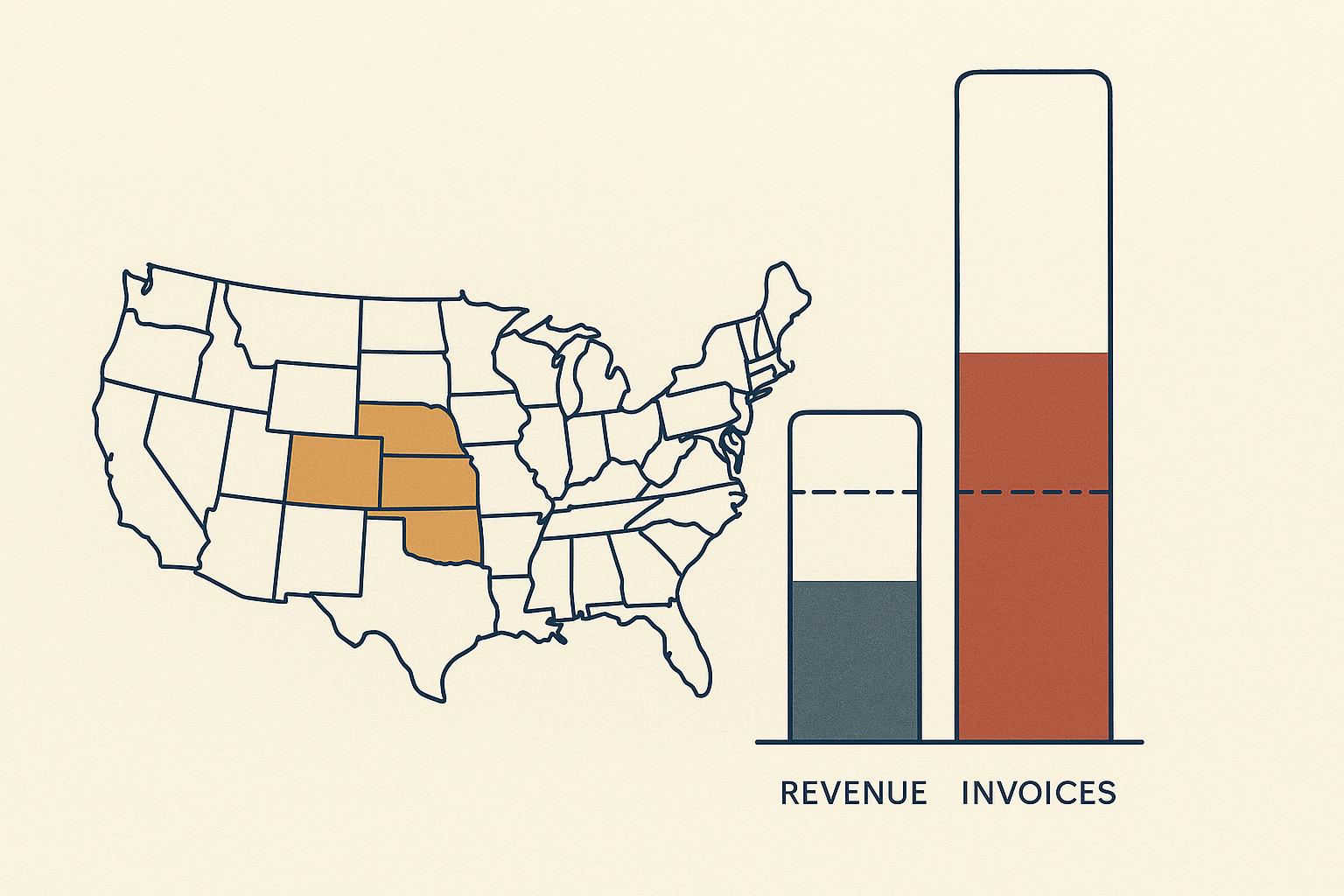
A composite founder diary (2026): at $41K MRR I found out I had crossed sales tax registration thresholds in five US states without noticing, because a monthly subscription bills each customer twelve times a year and the 200-transaction test counts invoices, not dollars. What economic nexus is, why subscriptions trip it at a third of the revenue you would expect, why uncollected tax comes out of your margin instead of your customers' pockets, how a voluntary disclosure agreement capped the damage, and why January 1, 2027 is on the calendar for anyone selling into California.

The month Delaware billed me $102,215 and I actually owed $850, at $52K MRR
A composite founder diary. A Delaware annual report notice arrived for $102,215 against $52K MRR. The real figure was $850, and the notice was not an error: Title 8 section 503(b) makes the Authorized Shares Method the statutory default until you report your issued shares and gross assets at the time of filing.
The month a director saw more than a stockholder, at 83K MRR
A composite founder diary at 83K MRR. Delaware's 2025 amendment narrowed what a stockholder can demand under Section 220, but subsection (d) still lets a director reach other corporate records, with the burden of proof on the company.