The month SaaS sales tax caught up with me at $41K MRR: a founder diary (2026)
A composite founder diary (2026): at $41K MRR I found out I had crossed sales tax registration thresholds in five US states without noticing, because a monthly subscription bills each customer twelve times a year and the 200-transaction test counts invoices, not dollars. What economic nexus is, why subscriptions trip it at a third of the revenue you would expect, why uncollected tax comes out of your margin instead of your customers' pockets, how a voluntary disclosure agreement capped the damage, and why January 1, 2027 is on the calendar for anyone selling into California.
In this story
“You have been selling into that state for two years. When did you register?”
I did not have an answer. I was sitting at $41,000 MRR in 2026, on a call with an accountant I had hired to clean up my books before an annual audit, and she had just asked me the one question I had never thought to ask myself. Not how much I was making. Where my customers were, and what that made me responsible for.
Quick answer (2026): This is a composite founder diary about discovering, at $41K MRR, that I had crossed sales tax registration thresholds in several US states without noticing, because a monthly subscription bills each customer twelve times a year and transaction-count thresholds count invoices, not dollars. SaaS is now taxable in some form in 26 US states, and California starts taxing remotely accessed software on January 1, 2027. The part that hurt was not the tax rate. It was that you cannot go back and bill customers who already paid, so uncollected sales tax comes out of your gross margin, not theirs. A voluntary disclosure agreement capped the damage. This is what I wish I had understood two years earlier.
The thing I thought sales tax was
I thought sales tax was a thing that happened in shops.
My mental model, which I had never once examined, went like this: I am a small software company, I have no offices and no warehouses, I am not physically present anywhere except my apartment, and therefore I owe income tax where I live and nothing to anybody else. Stripe took the money, my bank received it, my accountant filed my return, and the machine seemed to work.
That model was correct until June 21, 2018, and I had built my business on it in 2024. In South Dakota v. Wayfair, the US Supreme Court threw out the physical-presence requirement and let states tax remote sellers based purely on economic activity. South Dakota's threshold, the one the Court blessed and most states copied, was $100,000 in gross revenue or 200 separate transactions in the state (Sales Tax Institute). Some states set their own numbers. New York, for example, requires $300,000 and 100 transactions.
I had read that sentence before. I had read it as a rule about big companies. It is not. It is a rule about arithmetic, and the arithmetic of a subscription business is unusual in a way nobody had pointed out to me.
The multiplier nobody had mentioned
Here is the thing that made me feel genuinely stupid, and then genuinely annoyed that no guide had spelled it out.
Every explainer I found stated the threshold as "$100,000 or 200 transactions" and then moved straight on to a state-by-state table. But read it again with a subscription in mind. A subscription bills each customer twelve times a year. The dollar test counts revenue. The transaction test counts invoices. Those two numbers grow at wildly different rates when your product is a monthly charge.
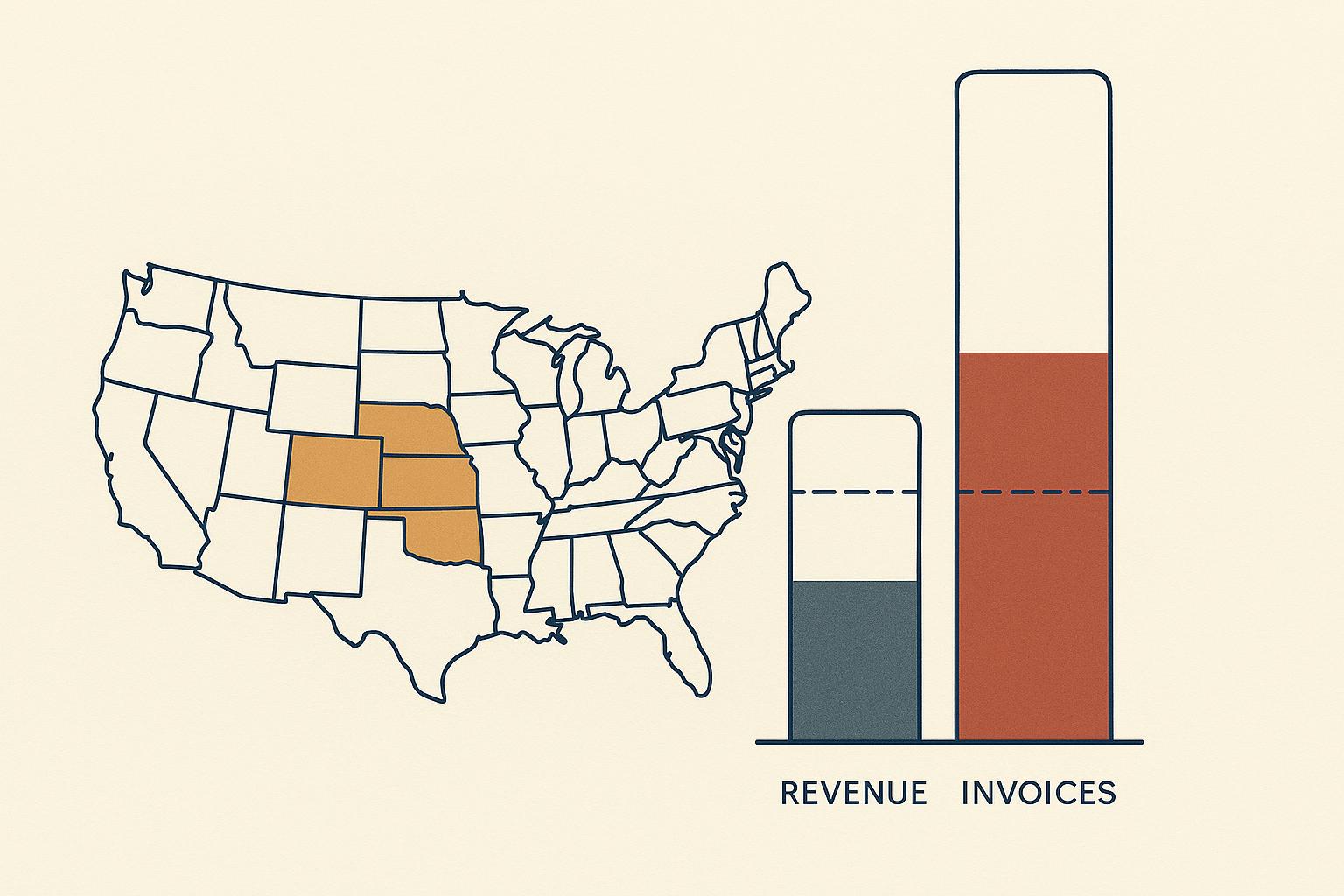
My product sat at about $49 a month, which at $41K MRR meant roughly 840 paying accounts. Take one mid-sized state where about 6% of my customers lived. That is around 50 accounts. Now run both tests:
- Dollar test: 50 accounts x $49 x 12 months = about $29,400 a year. Nowhere near $100,000. Comfortably invisible.
- Transaction test: 50 accounts x 12 invoices = about 600 transactions a year. Three times over the 200 threshold.
I had been watching the wrong number. I had been watching the only number I had ever seen quoted in a headline. A business selling a $500 one-time product needs 200 customers in a state to trip the transaction test and would hit $100,000 at the same moment, so for them the two tests roughly agree. A monthly subscription trips the transaction test at roughly a third of the revenue a one-time-purchase seller needs, because it manufactures twelve taxable events per customer per year whether it grows or not.
There is a grim irony here worth knowing: states have been steadily abolishing the transaction-count test, partly because it catches exactly this kind of small high-frequency seller and generates administrative work for almost no revenue. South Dakota itself dropped its transaction threshold. That is genuinely good news for founders starting now. It did nothing for the two years I had already been quietly non-compliant.
Then it got more complicated, because SaaS
Crossing a threshold only matters if what you sell is taxable in that state, and this is where software gets special.
Physical goods are broadly taxable nearly everywhere. SaaS is a patchwork, because most state tax codes were written before anybody accessed software over a wire, and each state has since improvised. As of 2026, software and SaaS are taxable in some form in 26 US states (Anrok, 2026). Stripe's guide puts it slightly differently, counting 25 states that tax SaaS services outright plus another 7 that tax it only if the customer downloads something (Stripe, November 2025). The two counts do not disagree so much as demonstrate the problem: reasonable people reading the same statutes arrive at different tallies.
The improvisation gets genuinely strange up close. Texas decided cloud software is a data processing service, and taxes it at 80% of the sales price while exempting the other 20%, a split that came out of court decisions rather than a clean legislative choice (Texas Society of CPAs, February 2026, Rule 3.330(g)). So in Texas I did not owe tax on my subscription. I owed tax on four fifths of it.
I want to be precise about what I felt at this point, because it was not panic. It was the specific vertigo of realising that a whole dimension of my business existed, had existed the entire time, was legally binding, and I had simply never looked at it. The same feeling I had the month my gross margin finally scared me, except that one was a number I had been avoiding. This was a number I did not know existed.
The bill nobody else can pay
Then my accountant explained the part that actually cost me money, and it is the part I most want other founders to understand, because none of the guides say it plainly.
Sales tax is supposed to be a pass-through. The customer pays it, you collect it, you forward it to the state. You are a courier. If I had registered on day one, I would have added tax on top of $49, the customer would have paid $52-something, and my margin would have been untouched. The tax was never meant to be mine.
But I did not collect it. And you cannot go back to a customer who paid you correctly, in full, eighteen months ago and send them a surprise invoice for the tax you forgot to add. Some enterprise contracts have clauses for that. A self-serve subscription does not. Practically, that money is gone.
So the state's claim lands on me, and it lands as a straight subtraction from gross margin on revenue I already recognised, already spent, and already reported as profit. Working through the look-back with her, my exposure came out around $180,000 of taxable base across five states, which at a blended rate near 6.5% is about $11,700 of tax I should have collected and did not. Plus penalties. Plus interest, which had been quietly accruing the entire time.
Eleven thousand seven hundred dollars is not a company-ending number at $41K MRR. It was about three weeks of revenue. But it was three weeks of revenue for a mistake with no upside whatsoever, no product built, no customer served, no lesson that a competent adviser could not have told me for a few hundred dollars in year one.
The mechanism that capped the damage
The genuinely useful thing I learned, and the reason I am writing this down, is that there is a formal process for exactly this situation, and almost nobody I have talked to since had heard of it.
It is called a voluntary disclosure agreement. It is a contract between you and a state where you come forward before they find you, and in exchange the state limits how far back it will look and reduces or waives penalties. The look-back is typically capped at three or four years for sales tax rather than reaching back to whenever you first created nexus, penalties are usually reduced or eliminated, and interest treatment varies by state (Sales Tax Institute). In most states you can negotiate it anonymously through a CPA or attorney, so you are not putting your name on the table until the terms are agreed. New York and Washington are notable exceptions on the anonymity point.
The two disqualifiers are what turned this from interesting into urgent. A VDA is generally unavailable once the state has already contacted you about an audit, and it is usually unavailable in a state where you are already registered. In other words the entire value of the mechanism sits in the window before anybody notices you, and that window closes on somebody else's schedule, not yours. My accountant's phrasing, which I have repeated to three founders since: the discount is for volunteering, and you stop being a volunteer the moment a letter arrives.
We filed in the states where the exposure justified the professional fees, and we registered going forward in the rest. The penalty relief covered a meaningful share of what I had been braced for.
The deadline sitting in front of everyone reading this
While I was cleaning up my past, California legislated my future.
For more than thirty years California did not tax prewritten software that was downloaded or accessed remotely. It taxed software delivered on physical media, a rule that made sense when software arrived in a box and has made progressively less sense every year since. SB 122 ends that. Signed in 2026, it amends Revenue and Taxation Code section 6016 to redefine tangible personal property to include digital products, which explicitly covers prewritten software accessed remotely, and it takes effect January 1, 2027 (Holland & Knight, July 2026).
The scale of it is in the state's own numbers. California's Legislative Analyst's Office projected roughly $450 million in General Fund revenue plus $560 million in local sales tax for the half-year of 2026-27, rising to about $900 million and $1.1 billion annually from 2027-28 (California LAO, May 2026). That is a rough measure of how much SaaS revenue is about to become taxable in one state.
Two details from the statute matter operationally. Custom software built to special order stays exempt, but that exemption does not rescue software that is held for general or repeated sale even if it started as a custom build, which is precisely the origin story of a lot of small SaaS. And sourcing runs off the purchaser's California address in a set priority: billing address first, then shipping, then the payment instrument's mailing address, then the purchaser's mailing address. So which address you happen to collect at signup quietly determines your obligations.
I do not have California customers in enough volume to have crossed a threshold there yet. Plenty of people reading this do. If that is you, you have one budget cycle.
What I actually changed
Four things, none of them clever.
I stopped treating tax as something my accountant handles at year end and started treating it as billing infrastructure, which is what it is. I turned on automated tax calculation in my billing stack so the determination happens at checkout by the customer's address instead of being reconstructed by a human eighteen months later. This is exactly the reasoning that makes founders reach for a merchant of record instead, which shifts the liability to the platform, a tradeoff I had looked straight past when I wrote about the number Lemon Squeezy hit before Stripe bought it without registering that its actual product was somebody else absorbing this entire problem.
I built a nexus dashboard, which is a grand name for one query. Revenue and invoice count, grouped by state, for a rolling twelve months, with the relevant threshold next to each row. It took an afternoon. It replaces the thing I had been doing, which was nothing.
I started collecting a billing address properly at signup rather than treating it as friction to be minimised. Every field I had trimmed for conversion was a field I later had to reconstruct from card metadata during a look-back.
And I built the tax line into how I think about price. Every time I had modelled a pricing change, I had modelled discount and churn carefully and never once modelled the tax, which is a real component of what a customer actually pays and therefore of what they will tolerate.
What actually happened
MRR went from $41K to about $43K over the following quarter, which tells you nothing, because none of this was a growth project. Sales tax compliance does not appear on a dashboard. Done correctly it is invisible. Done incorrectly it is invisible right up until it is a wire transfer.
The real change is that a category of unbounded liability became a line item I can see. Before, I did not know what I owed, in how many states, going back how far. Now I have a number, it is bounded, and it updates itself. The dollar cost was about three weeks of revenue. The cost of finding out from a letter instead of from an accountant I hired on purpose would have been considerably worse, and I would have lost access to the one mechanism that made it affordable.
One honest caveat, because this is a diary and not advice: the details here are specific to my composite situation in 2026, tax law moves constantly, and the single highest-return decision in this whole story was paying a specialist rather than reasoning it out myself. Do that part first.
The one thing I would tell you
Count your invoices, not just your revenue.
If you sell a monthly subscription, you are generating twelve taxable events per customer per year, and the transaction-count thresholds that everybody quotes as a big-company problem will find you at a third of the revenue you assume. Run the query. Revenue and invoice count by state, rolling twelve months, against each state's threshold. If you are already over somewhere, understand that a voluntary disclosure agreement is worth far more before anyone contacts you than after, and that the money comes out of your margin rather than your customers' pockets because that ship has sailed. If you sell into California, January 1, 2027 is on the calendar whether you have looked at it or not.
I spent two years feeling responsible about the parts of my business I could see on a chart. The expensive part was the dimension I had never thought to plot.
Written by
Anya PetrovaAnya Petrova writes first-person founder diaries for OperatorBook, reconstructed as composites from interviews with bootstrapped SaaS founders. She focuses on the months that do not make the highlight reel: the pricing changes, the churn scares, and the quiet operational decisions that move MRR.
Frequently asked questions
Is this a real founder's diary?
It is a composite. The founder is a blend of several bootstrapped SaaS operators who cleaned up their US sales tax position in 2026. The MRR figures (about $41K rising to roughly $43K), the roughly $49 price point, the five-state exposure and the approximately $11,700 of uncollected tax are self-reported and lightly rounded, but the discovery, the transaction-count arithmetic, the voluntary disclosure process and the fixes are drawn faithfully from real experiences. Nothing here is tax advice; the single best decision in the story was hiring a specialist.
Does a small SaaS company have to charge sales tax?
It depends on where your customers are, not where you are. Since South Dakota v. Wayfair (June 21, 2018) states can require a remote seller with no physical presence to register once it crosses that state's economic nexus threshold, commonly $100,000 in gross revenue or 200 separate transactions in the state. It also depends on whether your state treats SaaS as taxable at all: as of 2026, software and SaaS are taxable in some form in 26 US states.
Why do subscription businesses cross the 200-transaction threshold so early?
Because the transaction test counts invoices, not customers, and a monthly subscription bills each customer twelve times a year. Fifty accounts in one state at $49 a month generates about 600 taxable transactions annually while producing only about $29,400 of revenue, so the transaction threshold is breached three times over while the dollar threshold is not remotely close. A one-time-purchase seller hits both tests at roughly the same moment; a subscription trips the transaction test at roughly a third of the revenue. Note that states have been steadily abolishing the transaction-count test, so this trap is narrowing over time.
Who pays sales tax you failed to collect?
You do. Sales tax is designed as a pass-through that the customer pays and you forward to the state, but you cannot retroactively invoice a self-serve customer who already paid in full months ago. So back liability lands as a direct subtraction from your gross margin on revenue you already recognised and spent, which is why the same rate feels far more expensive in arrears than it would have at checkout.
What is a sales tax voluntary disclosure agreement?
A voluntary disclosure agreement (VDA) is a contract where you approach a state before it finds you, and in exchange the state limits how far back it will look, typically to three or four years for sales tax, and reduces or waives penalties. Interest treatment varies by state. In most states you can negotiate anonymously through a CPA or attorney, though New York and Washington are exceptions. Critically, a VDA is generally unavailable once the state has contacted you about an audit, or in a state where you are already registered, so all of its value sits in the window before anyone notices you.
Is SaaS taxable in California?
Not yet, but that changes on January 1, 2027. California went more than thirty years without taxing prewritten software that was downloaded or accessed remotely. SB 122 amends Revenue and Taxation Code section 6016 to redefine tangible personal property to include digital products, which covers remotely accessed prewritten software, effective January 1, 2027. California's Legislative Analyst's Office projected roughly $450 million in General Fund plus $560 million in local sales tax revenue for the half-year of 2026-27, rising to about $900 million and $1.1 billion annually thereafter.
How does Texas tax SaaS?
Texas treats cloud-based SaaS as a taxable data processing service and taxes 80% of the sales price, exempting the remaining 20%, under Texas Sales Tax Rule 3.330(g). That split came out of multiple Texas court decisions rather than a clean legislative choice. Traditional software licences are taxed at 100% instead.
More stories
The month my gross margin scared me at $38K MRR: a founder diary (2026)
At $38K MRR my revenue looked healthy, but my gross margin was only about 62%, well under the 75% SaaS benchmark, mostly because of AI feature costs. Here is the month of margin surgery that took it to 76% without touching what customers valued.

Lemon Squeezy Revenue: The $1M Number It Hit Before Selling to Its Biggest Rival (2026)
Lemon Squeezy hit $1M ARR in nine months, turned down a $50M Series A, then sold to Stripe for an undisclosed sum. An honest, source-typed revenue ledger, and why the disclosed number is the least interesting part.
The month a website accessibility lawsuit threat landed at $45K MRR: a founder diary (2026)
A composite founder diary (2026): at $45K MRR a twelve page ADA demand letter arrived by certified mail alleging eleven barriers and giving fourteen days to respond. Why a demand letter is not a website accessibility lawsuit and what that changes, why the published filing counts of 3,117 and 4,928 describe a category I was not in, the overlay widget I nearly bought at 11pm, the nine defects behind the eleven allegations, and what the whole month actually cost.