The month one customer became 40% of my MRR at $36K: a founder diary (2026)
At $36K MRR I realized one customer was nearly 40% of my revenue. Why single-customer concentration is dangerous even when they stay, and the boring playbook that cut it to under 30%.
In this story
“I got the renewal signed and felt my stomach drop instead of lift. One customer was now almost half of everything I had built.”
Quick answer (2026): At $36,000 MRR, running my SaaS alone, I finally admitted that one customer had quietly grown to about $14,000 a month, close to 40% of my revenue. The common rule of thumb is that no single customer should exceed roughly 10% of revenue, and your top five should stay under about 25% (re:cap, 2026); once one account passes a third of the total it is widely treated as high risk, because losing it would erase a third of the business in a single email (MetricHQ, June 2026). I did not fire the customer or panic. Over the next three quarters I moved them to an annual prepay with real notice terms, stopped building the roadmap around them alone, and deliberately grew the small accounts I had been ignoring. The concentration fell from about 40% to under 30%, and MRR grew from $36K to roughly $52K.
This is a composite founder diary. The founder is anonymized and the dollar figures are self-reported and rounded. The customer-concentration thresholds and SaaS retention ranges are sourced and year-tagged in the Sources section.
The renewal that should have felt good
The email said yes. A twelve-month renewal, signed, from the biggest customer I had ever landed. Eighteen months earlier that signature would have had me pacing the flat and texting everyone I knew. This time I read it twice, closed the laptop, and felt something closer to dread.
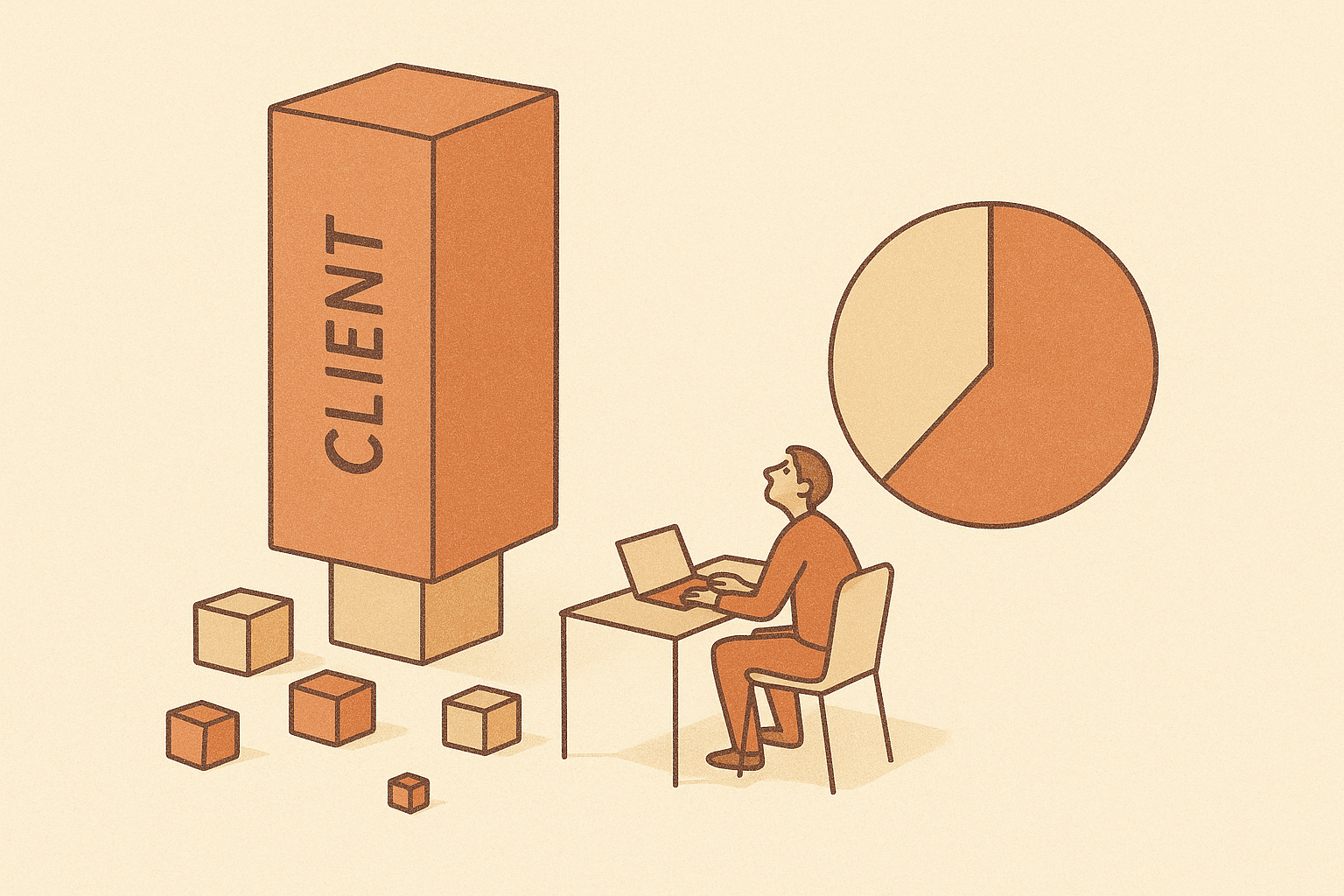
I sat with it for a while before I understood why. That one account was paying me about $14,000 a month. My total was $36K MRR. I did the division I had been avoiding for most of a year, and the answer was almost 40%. Nearly two of every five dollars I earned came from a single logo, a single procurement team, a single champion who could get promoted, reorganized, or hit by a budget freeze at any time.
The renewal was not good news. It was a lease on the same risk for another twelve months.
How I got here without noticing
Nobody sets out to build a business that leans on one customer. It happens the way most dangerous things happen to solo founders, one reasonable yes at a time.
It started when I closed my first real enterprise deal. That account came in bigger than any three self-serve customers combined, and it kept expanding. They added seats. They asked for a feature, I built it, they upgraded. They asked for another, I built that too. Every request came with more revenue attached, and every month the graph went up and to the right, so it all felt like winning.
What I could not see from inside the month-to-month was the shape of the thing. The self-serve side of my business, the small teams paying $40 and $90 a month, had barely grown in a year, because I had quietly stopped working on it. All my building energy went to the customer who paid the most and asked the loudest. My product had become, without any decision on my part, mostly their internal tool that a few hundred other people also happened to use.
The number I had been avoiding
Customer concentration is not a hard metric to compute. You take the revenue from your largest customer and divide it by your total revenue (MetricHQ, June 2026). That is it. The reason founders avoid it is not the math, it is the answer.
Mine was about 40%. For reference, the widely repeated guidance is that a healthy SaaS keeps any single customer under roughly 10% of revenue, and the top five under about 25% (re:cap, 2026). MetricHQ walks through an example where one customer at 33% of a business is already flagged as high-risk concentration, because a single loss would wipe out a third of everything. I was past that line and pretending I was not.
I want to be honest about how the number crept up, because the creep is the whole lesson. No single month felt reckless. The account went from 12% to 18% to 25% to 40% in expansions of a few hundred dollars, and at every step the new revenue was real and welcome. Concentration is a slow leak, not a blowout. You do not notice you are underwater until you run the division you have been putting off.
What a customer at 40% actually costs you, even when they stay
The obvious risk is that they leave. I had read enough founder stories, including the month a founder watched their biggest customer walk, to know that a 40% account churning is not a bad month, it is an existential one. But sitting at that concentration taught me the quieter costs that show up long before anyone cancels.
The first is roadmap capture. When one customer is 40% of your revenue, their feature requests stop being requests. You build what they need because you cannot afford not to, and slowly your product becomes a reflection of one company's internal process instead of your market's actual problem. I shipped three things that year that no other customer ever used.
The second is lost pricing power. You cannot hold a firm line on price, scope, or terms with an account that could take a third of your income out the door. Every negotiation is one you are afraid to lose, so you concede, and they learn that you will.
The third is the sleep tax. A concentrated business follows you home. I checked my email on holidays because one unhappy message from one champion could reset my entire year. That kind of low background fear does not show up in any metric, but it changes every decision you make, usually for the worse.
What I actually did about it
I did not do the dramatic thing. I did not fire the customer, and I would tell anyone in the same spot not to either. Firing 40% of your revenue to feel less exposed is just a faster way to the same cliff. What worked was boring and took three quarters.
First, I fixed the contract. At renewal I moved the account from month-to-month to an annual prepay with a proper notice period and a clearly scoped statement of what they were buying. That did not reduce the concentration by a single point, but it meant a churn could no longer happen in one afternoon by email. I bought myself warning time, which is the thing concentrated founders never have.
Second, I took the roadmap back. I wrote down every feature request from the big account and asked one question of each: would the median customer paying me $90 a month want this too. If the answer was no, it went to the bottom of the list unless they wanted to fund it as clearly separate custom work. My building energy went back to the problems my whole market shared.
Third, and this was the real fix, I grew the bottom. I spent the freed-up time on the self-serve funnel I had been starving: onboarding, a proper pricing page, two comparison articles, a weekly rhythm of small improvements for small customers. It is unglamorous work and none of it moved the needle in a single week. Over three quarters it moved everything. The small accounts compounded, MRR climbed from $36K to about $52K, and because that growth came from the bottom, the big customer's share fell from 40% to under 30% without me touching their revenue at all.
The account is still my largest. It is still around $15K a month. But it is now a large customer in a diversified business instead of the load-bearing wall of a fragile one. If they left tomorrow it would hurt, and I would keep the company.
I set one rule out of the whole episode and I still hold it: I watch the concentration number every month, and no single customer is allowed to sit above about 20% for long without a plan to bring it down. It is the cheapest insurance I have ever bought, and it costs nothing but the discipline to run the division I used to avoid.
The one thing to take from this: a customer who is 40% of your revenue is not a milestone, it is a mortgage. You do not fix it by firing them, you fix it by growing everything else until they are just a big name on a healthy list.
Keep reading
Sources
- re:cap, "SaaS Metrics: 6 KPIs Founders Must Know [2026]," updated September 1, 2025: keep no more than 10% of revenue from a single customer, or over 25% from your top five. https://www.re-cap.com/blog/kpi-metric-saas
- MetricHQ, "Customer Concentration," updated June 4, 2026: concentration equals the largest customer's revenue divided by total revenue; a worked example at 33.3% is labeled high-risk because losing that customer removes one-third of revenue. https://www.metrichq.org/saas/customer-concentration/
Written by
Anya PetrovaAnya Petrova writes first-person founder diaries for OperatorBook, tracing the unglamorous operating decisions behind real MRR milestones.
Frequently asked questions
What is customer concentration in SaaS?
Customer concentration measures how much of your revenue comes from your largest customers. You calculate it by dividing your single biggest customer's revenue by your total revenue (MetricHQ, 2026). A high number means a small number of accounts carry a large share of the business, so losing one has an outsized effect.
What percentage of revenue from one customer is too much?
A common rule of thumb is that no single customer should exceed roughly 10% of revenue, and your top five should stay under about 25% (re:cap, 2026). Once one account passes about a third of total revenue it is widely treated as high-risk concentration. Early on almost every founder is above these lines; the point is to have a plan to bring the number down as you grow.
Is customer concentration only a problem when you sell the company?
No. Concentration is an everyday operating risk, not just an exit issue. A dominant customer captures your roadmap, erodes your pricing power, and can remove a large share of revenue with a single cancellation. Those costs show up long before any acquisition conversation.
How do you reduce customer concentration as a solo founder?
The durable fix is to grow the rest of the business rather than firing the big account. Move the large customer to an annual contract with real notice terms so a churn cannot happen overnight, rebuild your roadmap around problems your whole market shares, and invest the freed time in your self-serve and smaller accounts so they compound. As the base grows, the big customer's share falls on its own.
Should you turn down a big customer to avoid concentration?
Usually not. A large customer is an opportunity; the mistake is letting them become the whole business by neglecting everything else. Take the deal, then deliberately diversify around it. Firing 40% of your revenue to feel safer just moves you to the same cliff faster.
How is customer concentration calculated?
Divide the revenue from your largest customer by your total revenue for the same period, then multiply by 100 (MetricHQ, 2026). For example, a customer paying $14,000 a month in a $36,000 MRR business is about 39%. You can run the same formula for your top five accounts to see grouped concentration.
More stories

The month my biggest customer left and took a third of my MRR
One acquired customer walked out with almost a third of my $24K MRR in a single month. A first-person 2026 diary on customer concentration risk, the cashflow scramble, and the concentration cap I live by now.

The month I closed my first enterprise deal at $21K MRR
The month my SaaS hit $21,000 MRR I signed my first enterprise deal: one $40,000-a-year contract worth 16% of my revenue. A first-person 2026 diary on the 280-question security review, the SSO build I pulled off the roadmap, net-60 cash delays, concentration risk, and the three rules I wrote afterward.

The month I misclassified an independent contractor, at $63K MRR
A composite founder diary. A contractor invoiced at $26 an hour for three years asked one question, and the number everyone quotes turned out to be the escapable one. Read end to end from the statute at $63K MRR.