Justin Welsh's Revenue Is Not the Point: Inside a $15M One-Person Business
Everyone copies Justin Welsh's audience. The number that actually explains his one-person business is the margin.
In this story
"The future belongs to lean, profitable, one-person businesses."
Justin Welsh, LinkedIn, March 2025
Most people who study Justin Welsh study the wrong number.
They look at the reach. 1.5M+ followers across platforms. 200,000+ readers on a newsletter he writes every Saturday, alone, and has for more than five years. The lesson they carry home is "build a huge audience, then sell something to it." So they spend a year chasing followers, launch a course into the void, and quietly conclude the whole model is a lie.
The number that actually explains the business is smaller, and much less fun to post about. It is the margin.
Quick answer
As of 2026, Justin Welsh runs a one-person business that his own site describes as a $15M operation "with no employees and no investors." In an essay published June 2025 he wrote that it had "passed $10M in total revenue" at "roughly 89%" profit margin. The engine is not the size of his audience. It is a pair of low-priced, evergreen digital courses sold at volume, with almost nothing spent to deliver them. Justin Welsh's revenue is the headline; the structure underneath it is the real lesson: high margin, no payroll, no product to maintain, and a free audience whose only job is to feed a paid catalog. Every figure below is his own, and year-tagged.
The exit before the solo run
The origin story is not "kid builds thing in a bedroom." In interviews and his own posts, Welsh describes roughly a decade in sales leadership, including helping scale two venture-backed companies past $50M in annual recurring revenue, before burnout and a health scare he has spoken about openly pushed him off the corporate track in 2019.
He kept the skill and dropped the structure. What he had learned selling enterprise software, positioning, funnels, relentless consistency, he pointed at an audience of aspiring solo operators instead of at buyers in a boardroom. That matters, and we will come back to it, because it is the part of the story that does not copy cleanly.
The audience is the distribution, not the product
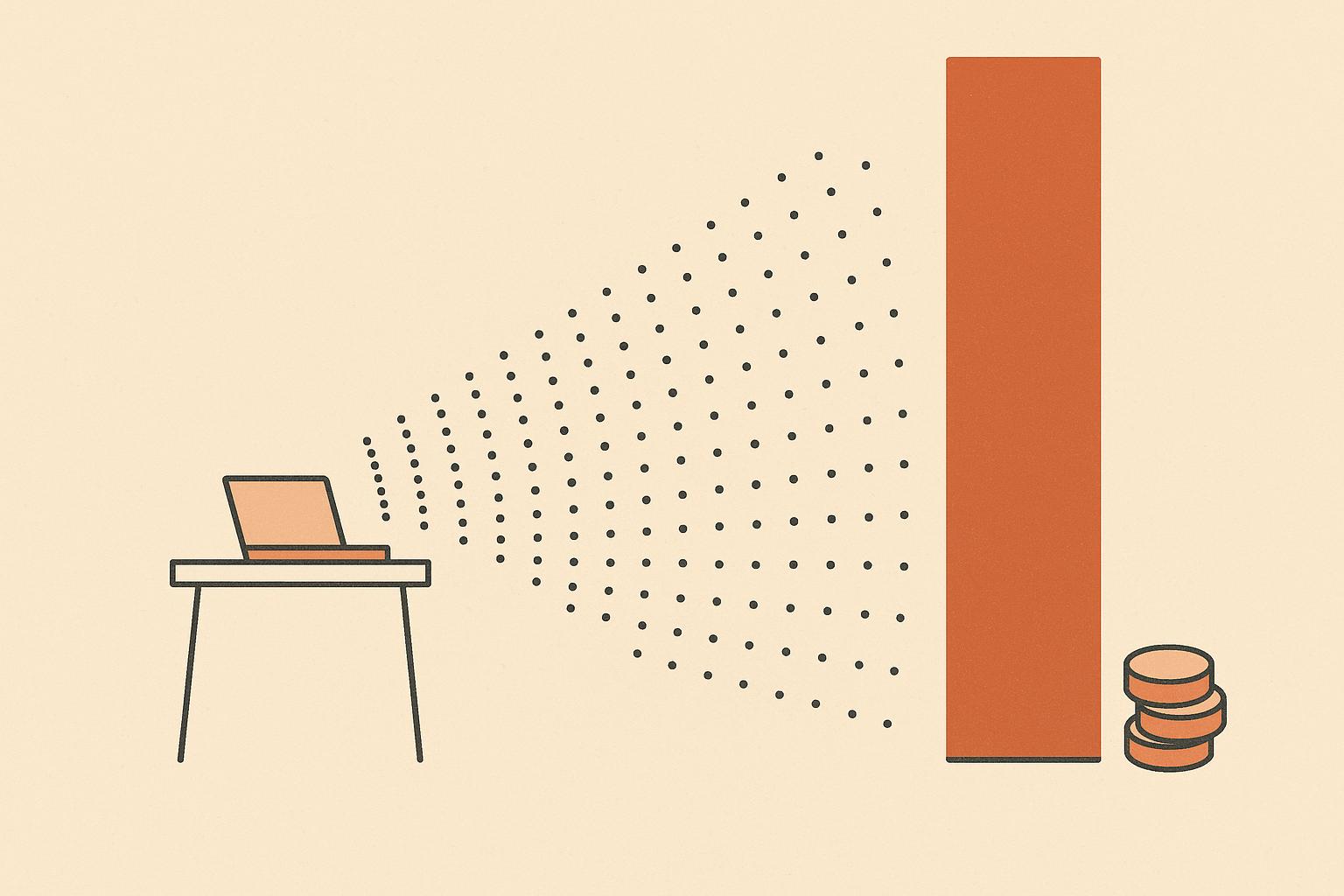
Here is the reframe. The audience is real and large, but it does not earn the money directly.


The money sits one layer down, in two evergreen products, LinkedIn OS and Content OS, priced around $150 each. Growth In Reverse, profiling him in February 2023, estimated the courses alone were doing roughly $1.3M a year. They are not subscriptions. There is no seat to renew, no churn to fight, no onboarding team. Someone buys once, downloads a system, and the transaction is done. For a team of one, that absence of a retention burden is the whole game.
Contrast that with the founder who built his real money-maker before he had any audience at all. Different route, same underlying truth: the audience is a channel, not the asset.
The margin is the moat
Now the number that matters.
A traditional $10M business carries a payroll, an office, a product roadmap, a support desk. After all of it, the owner might keep 10 to 20 cents on the dollar. Welsh keeps almost all of it. In his June 2025 essay he put the margin at "roughly 89%." His own 2024 year-in-review, posted in January 2025, listed "~86% margins" alongside doubled revenue and two new product launches.
At those margins the cost base is a rounding error: some software, a contractor here and there, his own time. That is what lets one person clear the kind of profit that used to require a company. It is the same structural advantage behind another solo operator whose real moat is a near-zero cost base, not a bigger top line.
Here is the trajectory, in his own reported figures.
Scroll to see more
| Date | What he reported | Source |
|---|---|---|
| May 2024 | About $7M revenue in roughly five years, near 90% margin | The Tilt (third-party) |
| January 2025 | 2024: doubled revenue, ~86% margins, 2 new products, +177K LinkedIn followers | Justin Welsh, LinkedIn |
| June 2025 | "Passed $10M in total revenue," ~89% margin | Justin Welsh, essay |
| 2026 | "$15M one-person business," 200,000+ readers, no employees | justinwelsh.me |
The honest asterisks
Read those figures the way he reports them, not the way the internet repeats them.
First, they are cumulative. $15M is lifetime revenue across roughly seven years, not an annual salary. The yearly run rate is a fraction of the headline, and the jump from "passed $10M" in mid-2025 to a "$15M" lifetime claim in 2026 is a marketing-site figure, not an audited one.
Second, survivorship. Welsh did not start from zero. He started with a decade of sales craft, a professional network, and a point of view already formed. The person copying his posting schedule without that foundation is running a different experiment.
Third, the model has a ceiling. A catalog of $150 products sold by one person eventually caps out on that person's attention. It is not a coincidence that he has since moved upmarket with a higher-priced program, the Creator MBA. The evergreen-catalog engine is durable, but it is not infinite.
Fourth, it is attention-dependent. Margins this high exist because distribution is free. The day a platform throttles reach, the top of that funnel narrows, and no amount of margin fixes a demand problem.
What you can actually copy
You cannot copy his decade or his timing. You can copy the structure.
- Optimize for margin, not for the headline revenue number. A smaller business you keep 85% of beats a bigger one you keep 15% of.
- Pick a product shape with no retention burden. For a team of one, a catalog you sell once beats a subscription you have to keep alive.
- Separate distribution from monetization. Give the audience away free, daily; charge for the system underneath it.
- Let consistency do the compounding. One channel, one topic, for years, beats five channels for five weeks.
The revenue is the part that gets screenshotted. The margin, the missing payroll, and the boring five-year consistency are the parts that actually built it.
Sources
- Justin Welsh, "My complete $10M journey (all 23 steps)," justinwelsh.me, June 2025.
- Justin Welsh, 2024 solopreneur year-in-review, LinkedIn, January 2025.
- justinwelsh.me, about and home pages, 2026.
- "Justin Welsh Built a $7M Content Business With This Strategy," The Tilt, May 2024.
- "How Justin Welsh Built a $1.7M Solo Business," Growth In Reverse, February 2023.
Written by
Anya PetrovaAnya Petrova writes for OperatorBook about the economics of small, profitable software and creator businesses. She is drawn to the boring numbers behind the exciting headlines.
Frequently asked questions
How much revenue has Justin Welsh made?
As of 2026 his own site describes a $15M one-person business, and in an essay published June 2025 he wrote it had "passed $10M in total revenue." These are cumulative lifetime figures reported by Welsh himself, not annual salary, and the yearly run rate is a fraction of the headline.
What is Justin Welsh's profit margin?
He has reported roughly 86% margins for 2024 and "roughly 89%" in a June 2025 essay. Margins that high are possible because he has no employees and sells evergreen digital products with almost no cost to deliver.
How does Justin Welsh make money?
Mainly two evergreen courses, LinkedIn OS and Content OS, priced around $150 each, plus a higher-priced program, the Creator MBA. His free newsletter and social posts drive attention; the paid catalog converts it.
How many employees does Justin Welsh have?
None. He describes it as a one-person business with no employees and no outside investors.
How big is Justin Welsh's audience?
His site cites more than 1.5M followers across platforms and over 200,000 subscribers to The Saturday Solopreneur newsletter as of 2026.
Can you copy Justin Welsh's business model?
You can copy the structure: high margin, a product with no retention burden, free distribution feeding a paid catalog, and years of consistency. You cannot copy his decade of prior sales experience or his timing, which is why results vary widely.
More stories

Pieter Levels revenue: the never-sell math behind a $3M solo portfolio
One person, no team, no VC, no exits, and about $3.1 million a year. The sourced numbers behind Pieter Levels' portfolio, and the never-sell structure that compounds them.

How FeedbackPanda Hit $55K MRR With No Audience
Arvid Kahl now teaches audience first, but FeedbackPanda hit $55K MRR in two years with no personal audience. Here is what actually drove the growth.
The month a website accessibility lawsuit threat landed at $45K MRR: a founder diary (2026)
A composite founder diary (2026): at $45K MRR a twelve page ADA demand letter arrived by certified mail alleging eleven barriers and giving fourteen days to respond. Why a demand letter is not a website accessibility lawsuit and what that changes, why the published filing counts of 3,117 and 4,928 describe a category I was not in, the overlay widget I nearly bought at 11pm, the nine defects behind the eleven allegations, and what the whole month actually cost.