The month I almost ran out of cash at $17K MRR
Updated on July 20, 2026
In this story
“The dashboard said seventeen thousand a month. The bank said nine hundred dollars. Both numbers were true, and that gap is the whole story.”
Quick answer (2026): You can be profitable on paper and almost out of cash in the same week, because profit and MRR are accrual numbers while cash is about timing. This is one founder's diary of running a healthy $17,000 MRR software business, one she had deliberately pushed onto annual-in-advance plans, and watching her bank balance fall from about $14,000 to roughly $900 in a single month, when a prorated annual refund, an unreserved quarterly tax bill, a payment-processor reserve hold, and one net-60 invoice all landed inside the same thirty days. The fix is not more revenue. It is a cash forecast kept next to the MRR chart, a tax reserve taken the day money lands, and runway measured in buffer days rather than in monthly recurring revenue.
I build a small scheduling and invoicing tool for home-service businesses, plumbers, cleaners, mobile groomers, on plans between $29 and $149 a month. By early 2026 it was doing about $17,000 MRR and, by every number I looked at, it was working. The profit and loss statement showed a comfortable margin. I paid myself, I paid one part-time contractor, and there was still a real number left over at the bottom. I told my partner we had finally made it.
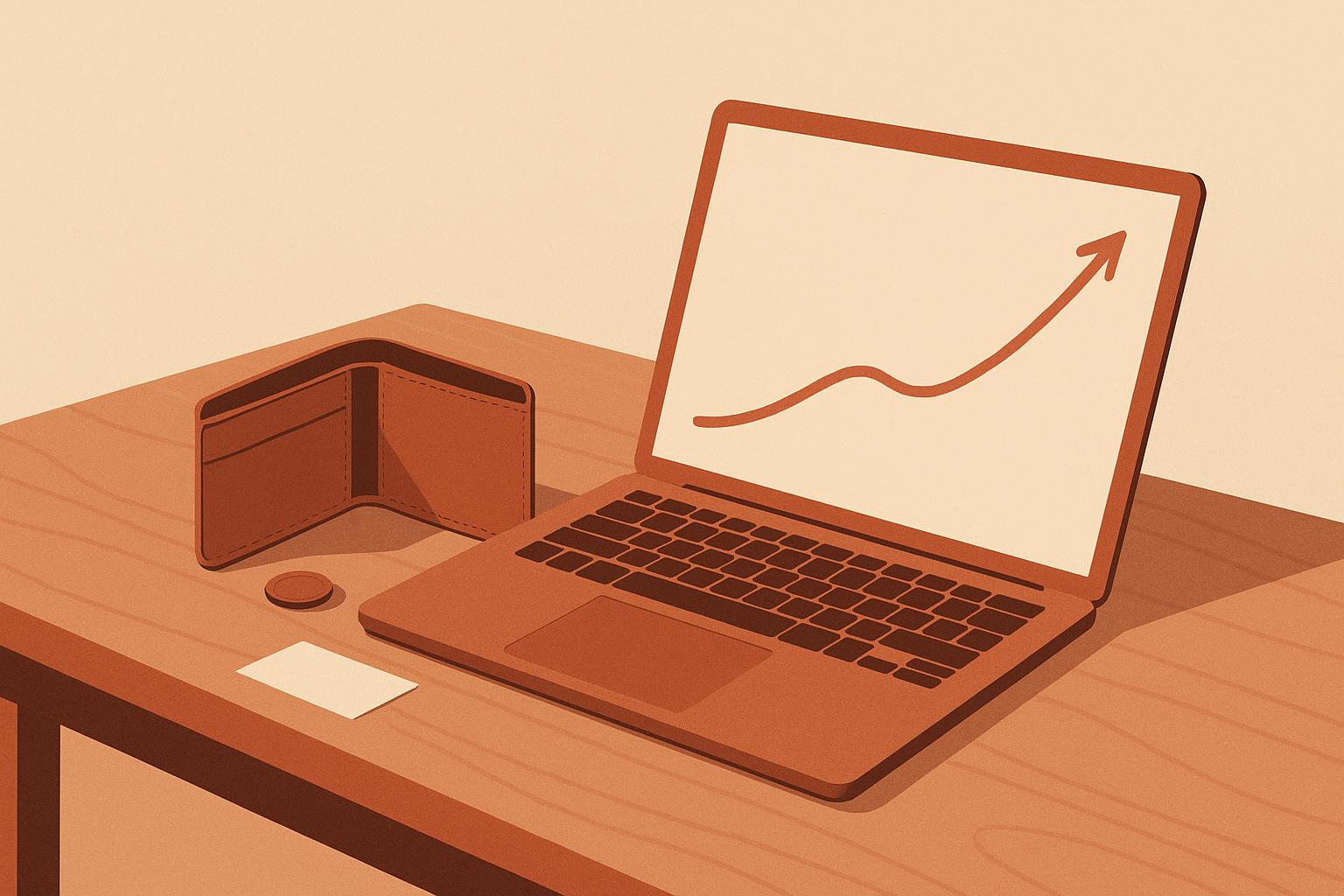
Then one Tuesday morning I opened the business bank account and my stomach dropped. $900. Not nine thousand. Nine hundred. I refreshed it twice. I checked I was in the right account. The money was gone, and I could not immediately tell you where it had gone, because on paper I had just had one of my best months.
Anya asked me to write this down in my own numbers, rounded and anonymized, because she said most founders learn this lesson the same way I did, alone and slightly panicking. So here it is.
Why a profitable business can still be cash poor
The thing nobody explained to me is that the two numbers I trusted most, MRR and profit, are both accrual numbers. They describe revenue I have earned and expenses I have incurred. Neither of them tells me how much money is actually sitting in the account today, or when it arrives, or when it leaves.
Cash is a timing problem. Profit is an accounting opinion. They only feel like the same thing when the timing happens to line up. The month they stop lining up is the month you find out the difference the hard way.
My situation was worse than average for a specific reason: about eighteen months earlier I had done the thing every cash-strapped founder is told to do. I pushed annual plans. Pay for a year up front, get two months free. It worked. It smoothed my cash and it funded a real runway. But it also quietly rewired how my business felt versus how it actually was.
When you sell annual up front, you collect a big slug of cash in month one and then recognize that revenue in small monthly slices for the next twelve months. Your MRR chart looks calm and healthy. Meanwhile the cash you collected months ago has usually already been spent. As the SaaS financing firm SaaS Capital described it in 2020, an annual-in-advance business that hits a wave of churn "will be out of cash almost immediately, well before the P&L would show it," because the cash falls much faster than the recognized revenue does. That was written about shrinking companies, but the timing trap is the same even when you are growing. I was living on money I had already collected and already used, and the P&L was hiding it behind a smooth line.
The four things that landed in the same thirty days
None of what hit me that month was a disaster on its own. That is the part I want you to sit with. Four ordinary, survivable events arrived in the same billing cycle, and together they nearly took the business out.
1. A prorated annual refund: about $2,700 out. One of my larger customers had prepaid $3,600 for an annual plan four months earlier. They got acquired, the new owners had their own tool, and they asked for a refund of the unused portion. That was fair, and my terms allowed it. But the cash they had paid me had long since gone into payroll and hosting. Refunding roughly $2,700 meant paying back money I no longer had.
2. A quarterly estimated tax payment: about $7,400 out. This is the one that still embarrasses me. All those annual prepayments had inflated my sense of how much of the money was mine. It was not. A big chunk of it was tax I had simply never set aside. When the quarterly estimated payment came due, it was roughly $7,400, and it came out of the same thin account as everything else.
3. A payment-processor reserve hold: about $3,100 frozen. That same month I had a small spike in disputes, three chargebacks from a confused customer and one genuine fraud attempt. My card processor responded by placing a rolling reserve on my account, holding back a slice of each payout for 90 days as protection. That money was not lost. It was just locked, right when I needed it. About $3,100 of what I thought was incoming simply did not arrive.
4. A net-60 enterprise invoice: $6,000 booked, $0 collected. I had closed my first real enterprise deal, the same kind of deal and the same net-60 payment terms I later wrote about when I closed my first enterprise deal. It was $6,000, and I had cheerfully counted it as revenue the day we signed. But net-60 means they pay sixty days later. On my P&L it looked like income. In my bank account it was a promise.
What the P&L said versus what the bank did
Here is the same month, side by side. The left column is the story my dashboard told me. The right column is what actually moved through the account. Both are real. Only one of them pays rent.
Scroll to see more
| The month, 2026 | On the P&L (accrual) | In the bank (cash) |
|---|---|---|
| Recurring revenue | +$17,000 recognized | most collected months earlier as annual prepay |
| New card payments that cleared | (blended into MRR) | +$9,500 in |
| First enterprise deal (net-60) | +$6,000 recognized | $0 collected |
| Prorated annual refund | small monthly ding | -$2,700 out |
| Quarterly estimated taxes | not a line I watched | -$7,400 out |
| Processor rolling reserve | invisible | -$3,100 frozen |
| Operating costs (my draw, contractor, hosting, tools) | -$10,200 | -$5,200 cleared this month |
| Bottom line | about $6,800 "profit" | about $900 left in the bank |
A $6,800 profit and $900 in the bank, in the same thirty days. That is not fraud and it is not incompetence, though it felt like both at 7 a.m. It is just what happens when four normal timing events stack.
What I actually changed afterward
I did not fix this by growing. Growing faster would have made it worse, because faster growth on annual plans means collecting even more money I would be tempted to spend before I understood which parts were really mine. I fixed it with four boring habits.
I built a 13-week cash-flow forecast and put it right next to the MRR chart, not buried in an accounting tool. Every known inflow and outflow gets a date: when the enterprise invoice actually clears, when quarterly taxes are due, when annual renewals hit. The MRR chart tells me if the business is healthy over months. The cash forecast tells me if I can make payroll on Friday. I needed both, and I had only been looking at one.
I started reserving tax the day money lands. Every payment that comes in, a fixed percentage moves immediately into a separate account I treat as untouchable. It is the single change that removed the most fear. The quarterly bill stopped being an ambush.
I set a real runway buffer and measured it in buffer days, not revenue. The JPMorgan Chase Institute found in 2016 that the median US small business holds just 27 cash buffer days, enough to survive 27 days with no money coming in, and that a quarter of small businesses hold 13 days or fewer. When I did the math, I had been running the company on a buffer of about eleven days without knowing it. I now hold a floor of three months of operating cash before I take a discretionary draw, and I count it in days, because dollars in the bank flatter you and days do not.
And I got honest about timing on every dollar I book. A signed net-60 invoice is not cash for sixty days. A refundable annual prepayment is a liability wearing a revenue costume. The same lumpiness showed up again, in a happier form, when my first annual plans came up for renewal and I finally understood the full cycle. Now, before I count anything as spendable, I ask one question: when does this actually hit the account, and what can claw it back.
The one thing I would tell you
Watch your bank balance and your MRR as two different instruments, because a profitable month and a nearly-empty account can be the same month. MRR tells you whether the business is working. Cash tells you whether it survives until the business working matters. Build the cash forecast this week, reserve your taxes on the next payment that lands, and know your runway in days. I promise it is a calmer way to run a company than refreshing your bank app at dawn.
FAQ
How can a business be profitable but still run out of cash?
Profit and MRR are accrual figures: they count revenue you have earned and costs you have incurred, regardless of when the money actually moves. Cash is about timing. If you collect annual prepayments and spend them, book revenue on net-60 terms, owe taxes you did not reserve, or have funds frozen by a processor, your account can run dry in a month the P&L calls profitable.
Why do annual plans make cash flow more dangerous, not safer?
Annual plans give you a large slug of cash up front, which feels safe, but you recognize that revenue slowly over twelve months while usually spending the cash much sooner. If customers churn or request prorated refunds, or if a cohort renews poorly, the cash can fall far faster than your MRR chart shows. SaaS Capital documented this timing gap in 2020.
What are cash buffer days and how many should a SaaS founder hold?
Cash buffer days are how many days your business could survive with no money coming in, based on your average daily outflows. The JPMorgan Chase Institute found the median US small business holds only 27 buffer days (2016). For a bootstrapped SaaS with lumpy annual and net-terms cash, aim well above that; a common target is three to six months of operating costs.
Should I set aside money for taxes from SaaS revenue?
Yes. Move a fixed percentage of every payment into a separate account the day it lands, before you treat any of it as spendable. Annual prepayments especially inflate how much of the money feels like yours when a large share is really deferred revenue and tax owed later.
What is a payment-processor rolling reserve and why did it freeze my money?
A rolling reserve is when your card processor holds back a percentage of your payouts for a set period, often 90 days, as protection against chargebacks and fraud. Processors apply it after a dispute or fraud spike. The money is not lost, but it is unavailable exactly when a cash crunch is most likely.
How do I build a simple cash-flow forecast alongside MRR?
List every expected inflow and outflow for the next 13 weeks with real dates: card payouts, when net-terms invoices actually clear, payroll, hosting, quarterly taxes, annual renewals. Update it weekly. It sits next to your MRR chart, not inside your accounting software, so you see runway and revenue at the same time.
Keep reading
- The month I closed my first enterprise deal at $21K MRR, where net-60 terms first taught me that booked revenue is not collected cash.
- The month my first annual plans came up for renewal at $19K MRR, the other half of the annual-plan story: how prepaid cash defers churn instead of removing it.
This is a composite, first-person account. The founder and product are anonymized, and every figure is self-reported and rounded to protect the businesses involved. The pattern, being profitable on paper while nearly out of cash, is faithful to how this repeatedly happens to real bootstrapped founders. No real names, quotes, or exact revenue figures are reproduced.
Written by
Anya PetrovaAnya Petrova writes for OperatorBook about the economics of small, profitable software and creator businesses. She is drawn to the boring numbers behind the exciting headlines.
Frequently asked questions
How can a business be profitable but still run out of cash?
Profit and MRR are accrual figures: they count revenue you have earned and costs you have incurred, regardless of when money actually moves. Cash is about timing. If you collect annual prepayments and spend them, book revenue on net-60 terms, owe taxes you did not reserve, or have funds frozen by a processor, your account can run dry in a month the P&L calls profitable.
Why do annual plans make cash flow more dangerous, not safer?
Annual plans give you a large slug of cash up front, which feels safe, but you recognize that revenue slowly over twelve months while usually spending the cash much sooner. If customers churn or request prorated refunds, or if a cohort renews poorly, the cash can fall far faster than your MRR chart shows. SaaS Capital documented this timing gap in 2020.
What are cash buffer days and how many should a SaaS founder hold?
Cash buffer days are how many days your business could survive with no money coming in, based on your average daily outflows. The JPMorgan Chase Institute found the median US small business holds only 27 buffer days (2016). For a bootstrapped SaaS with lumpy annual and net-terms cash, aim well above that; a common target is three to six months of operating costs.
Should I set aside money for taxes from SaaS revenue?
Yes. Move a fixed percentage of every payment into a separate account the day it lands, before you treat any of it as spendable. Annual prepayments especially inflate how much of the money feels like yours when a large share is really deferred revenue and tax owed later.
What is a payment-processor rolling reserve and why did it freeze my money?
A rolling reserve is when your card processor holds back a percentage of your payouts for a set period, often 90 days, as protection against chargebacks and fraud. Processors apply it after a dispute or fraud spike. The money is not lost, but it is unavailable exactly when a cash crunch is most likely.
How do I build a simple cash-flow forecast alongside MRR?
List every expected inflow and outflow for the next 13 weeks with real dates: card payouts, when net-terms invoices actually clear, payroll, hosting, quarterly taxes, annual renewals. Update it weekly. Keep it next to your MRR chart, not inside your accounting software, so you see runway and revenue at the same time.
More stories

The month I closed my first enterprise deal at $21K MRR
The month my SaaS hit $21,000 MRR I signed my first enterprise deal: one $40,000-a-year contract worth 16% of my revenue. A first-person 2026 diary on the 280-question security review, the SSO build I pulled off the roadmap, net-60 cash delays, concentration risk, and the three rules I wrote afterward.

The month Delaware billed me $102,215 and I actually owed $850, at $52K MRR
A composite founder diary. A Delaware annual report notice arrived for $102,215 against $52K MRR. The real figure was $850, and the notice was not an error: Title 8 section 503(b) makes the Authorized Shares Method the statutory default until you report your issued shares and gross assets at the time of filing.