The month I switched to annual-first pricing at $32K MRR: a billing diary (2026)
A composite founder diary (2026): the month I rebuilt my pricing page around annual billing at $32K MRR. Why monthly billing was quietly leaking customers, what ChartMogul's 2024 data shows about annual retention (62% versus 41% for monthly), the discount and cash-timing tradeoffs, and why I defaulted new signups to annual instead of forcing everyone onto it.
In this story
“Your MRR barely moved, but your bank balance just tripled. Which number are you actually running the company on?”
My accountant asked me that in 2026, a few weeks after I rebuilt my pricing page around annual billing. I was sitting at $32,000 MRR and I genuinely did not have a clean answer. The dashboard I had trusted for three years had quietly stopped telling me the truth.
Quick answer (2026): This is a composite founder diary about switching a bootstrapped SaaS to annual-first pricing at $32K MRR. Annual plans measurably reduce churn (ChartMogul's 2024 data shows 62% annual retention versus 41% monthly at low price points) and collect a year of cash upfront, but they flatter your headline MRR, cost you roughly two months of revenue in discount, and push all the risk into a single renewal date twelve months later. Making annual the default for new signups, without forcing existing monthly customers to move, captured most of the upside with far less of the damage.
How I ended up almost entirely monthly
I never decided to be a monthly-billing company. I just never decided not to be.
When you launch, monthly is the obvious default. It is the lowest commitment you can ask a stranger for, it makes your pricing look cheap in the headline number, and it feels honest: pay as you go, leave whenever. For a long time that was the right call. Low friction is worth a lot when nobody has heard of you.
So I ran almost entirely monthly for three years. By the time I hit $32K MRR, roughly 95% of my customers paid month to month. Annual existed as a dusty toggle almost nobody clicked, offering a vague discount I had never bothered to make compelling. I told myself monthly was customer-friendly. What it actually was, I found out later, was fragile.
The number that made me look
The thing that made me open the billing data was not a growth problem. Revenue was climbing. It was a churn problem I could feel but not see.
Every month a slice of customers left, and every month I replaced them and grew a little on top. Net, the line went up, so I stopped looking underneath it. Then I finally pulled twelve months of cancellations and lined them up against how those customers had been billed.
The split was ugly. My monthly logo churn was running around 4% a month, a hair above the roughly 3.5% average that billing tools report for B2B SaaS (Orb, 2025). My annual customers, the tiny 5% who had somehow found the toggle, had churned at almost nothing over the same year. Same product, same onboarding, same support. The only difference was how often I asked them to decide to keep paying me.
That is the part nobody tells you plainly. Monthly billing does not just delay revenue. It re-runs the cancel-or-stay decision twelve times a year for every customer, and every re-run is another chance to lose them. I was not losing people because my product was bad. I was losing them because I invited them to reconsider every thirty days.
What the research actually says (and where I broke with it)
Before I touched anything I read the people who study this at scale, instead of trusting one founder's spreadsheet.
The most useful thing I found was ChartMogul's billing analysis of more than 2,500 SaaS companies (ChartMogul SaaS Billing Report, 2024 data). The retention gap is not subtle. At low average revenue per account, under about $25, annual plans held a 62% median customer retention rate against just 41% for monthly, a 21 point gap. On net revenue retention it repeats: in the $250 to $500 range, annual plans posted a median 88% versus 76% for monthly. The report is blunt that any SaaS should introduce annual pricing as early as it reasonably can, because an annual customer makes one keep-paying decision a year instead of twelve.
The same report also told me when to ask. Monthly-to-annual upgrades cluster in the first few months, peaking around months two to four after signup, and a customer is roughly three times more likely to switch in month two than in month nine. Enthusiasm has a shelf life. If you wait until renewal season to pitch annual, you have already missed the window.
Here is where I broke with the obvious reading of it. The same data set carries a warning that the "go all annual" crowd skips: among the fastest-growing early-stage companies, the top quartile under $1M ARR leaned heavily on monthly billing and grew about 131% year over year, while companies relying more than 75% on annual plans slowed to roughly 15 to 18% median growth. Annual is not a free lunch. Lean on it too hard, too early, and you can trade real growth for the comfort of upfront cash.
So I did not do what the loudest advice says. I did not force everyone annual. I made annual the default choice for new signups, kept monthly one click away, and left every existing monthly customer exactly where they were. I had already learned once that dragging existing customers through a pricing change is how you manufacture backlash, back when I cut four plans down to two. I was not going to repeat that mistake in reverse.
The redesign
The change itself was small. The framing was everything.
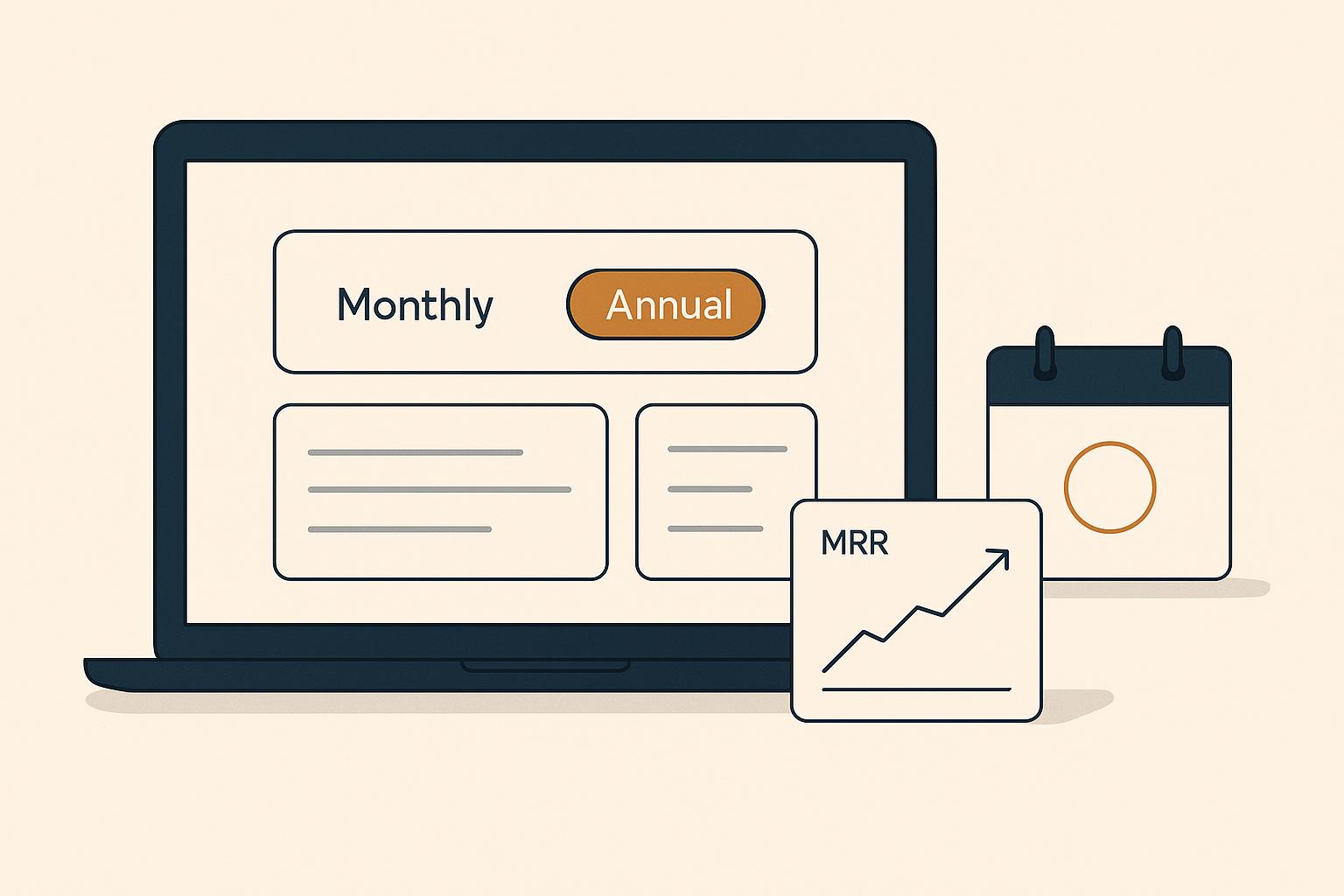
The old page showed a monthly price with a tiny "or pay annually" link underneath, styled like a footnote. The new page led with annual. The toggle defaulted to annual, the annual price was the big number, and the monthly price sat beside it as the smaller, more expensive-per-month option. The discount was two months free for paying yearly, which works out to about 17% off, framed not as a discount but as "two months on us."
I also stopped hiding the math. Under the annual price I wrote, in plain words, what the customer was actually buying: a year of the product, locked at today's price, with two months free. People do not resent paying annually. They resent feeling tricked into it. Spelling it out removed the friction I was afraid of.
For existing customers I sent one email. It said, roughly, nothing about your plan is changing, but if you want to lock in a year and grab two months free, here is the button. No countdown timer, no pressure. About 9% of my monthly base took it in the first two weeks, which was free cash I had been leaving on the table for three years.
The scary part nobody warns you about
Then my dashboard lied to me, and I almost panicked.
Because I book annual payments as MRR divided by twelve, not as a lump, my headline MRR barely moved in the first month even as my bank account jumped. A customer who switched from a $49 monthly plan to a $490 annual plan added $490 in cash but only about $41 in "MRR." For a few weeks it looked like all this work had done nothing, while I was actually collecting more money than I ever had.
This is the trap. Annual billing decouples your cash from your MRR, and if you are not careful you start managing the vanity number instead of the real one. I had to build two views: a bookings and cash view for whether the business was healthy, and an MRR view for the underlying subscription trend. They tell different stories now, and both are true.
The second scary part is quieter and further away. When you push a cohort onto annual, you do not learn whether they were happy for a whole year. Their churn is invisible until renewal, and then it arrives all at once. Twelve months of billing risk gets compressed into a single date, and if a chunk of that cohort walks, it lands in one brutal month. I know exactly how that feels, because I have lived through the month my first annual plans came up for renewal. Annual does not delete churn. It defers it, batches it, and hides it from you until it is too late to fix quietly.
What actually happened
Over the ninety days after the redesign, annual went from about 5% of new signups to roughly 40%. My cash collected in the quarter jumped hard, well ahead of what the MRR line suggested, and for the first time I had more than a month of runway that was not hostage to next month's card charges.
Involuntary churn dropped too, almost as a side effect. Annual customers only run their card once a year, so a whole category of failed-payment leakage simply stopped applying to 40% of new revenue. Retention on the new annual cohorts is tracking closer to the ChartMogul benchmark than to my old monthly numbers, though the honest truth is I will not fully know until those cohorts hit their first renewal.
MRR moved from $32K to about $34K over that quarter, which undersells it, because the cash and the retention improved far more than the headline. That gap between a modest MRR line and a much healthier bank balance is exactly the lesson.
The one thing I would tell you
Do not force annual. Default to it.
Make annual the obvious, pre-selected, clearly explained choice for every new customer, ask early while enthusiasm is high, and leave your existing people alone unless they opt in. You will capture most of the retention and cash-flow upside without the growth drag of an all-annual base or the trust damage of a forced migration. And the day you make the switch, build a second dashboard, because your MRR is about to stop being the whole truth.
Written by
Anya PetrovaAnya Petrova writes first-person founder diaries for OperatorBook, reconstructed as composites from interviews with bootstrapped SaaS founders. She focuses on the months that do not make the highlight reel: the pricing changes, the churn scares, and the quiet operational decisions that move MRR.
Frequently asked questions
Is this a real founder's diary?
It is a composite. The founder is a blend of several bootstrapped SaaS operators who moved to annual-first pricing in 2026. The MRR figures ($32K to about $34K), the churn rates, and the mix shift (annual from ~5% to ~40% of new signups) are self-reported and lightly rounded, but the decision, the dashboard scare, and the tradeoffs are drawn faithfully from real experiences.
Should a bootstrapped SaaS switch to annual-first pricing?
Usually yes, but default to annual rather than forcing it. Make annual the pre-selected, clearly explained choice for new signups and keep monthly one click away. This captures most of the retention and cash-flow upside without the growth drag of an all-annual base or the trust damage of migrating existing customers against their will.
Do annual plans actually reduce churn?
Yes, meaningfully. An annual customer makes one keep-paying decision per year instead of twelve, so there are far fewer moments to cancel. ChartMogul's analysis of 2,500-plus companies (2024 data) found a 62% median customer retention rate for annual plans versus 41% for monthly at low price points, a 21 point gap that persists on net revenue retention too.
Why did my MRR barely move after switching to annual?
Because annual payments are usually booked as MRR divided by twelve, not as a lump sum. A customer switching from a $49 monthly plan to a $490 annual plan adds $490 in cash but only about $41 in MRR. Your bank balance can jump while the headline MRR line looks flat. Track cash and bookings separately from MRR so you do not manage the vanity number.
How big should the annual discount be?
A common structure is two months free for paying yearly, roughly 17% off the monthly rate. The exact number matters less than the framing: present it as value the customer gains ('two months on us'), spell out plainly what a year of the product costs, and avoid making it feel like a pressured trick.
What is the downside of annual billing?
Three things. You give up roughly two months of revenue in discount; you defer and batch churn into a single renewal date twelve months out, where a departing cohort lands all at once; and you hide whether a cohort was happy until that renewal. ChartMogul's 2024 data also shows early-stage companies that lean more than 75% on annual can grow slower (about 15 to 18% versus 131% for monthly-heavy top performers), so over-relying on annual too early can trade real growth for upfront cash.
More stories


The month I cut my pricing from four plans to two at $37K MRR: a repackaging diary (2026)
A composite founder diary (2026): the month I deleted two of my four pricing plans at $37K MRR. Why a 'Business' tier only 6% of customers ever chose was taxing everyone, what the research says about three tiers (and why I went to two), the scary first-week conversion dip, and how simplifying took trial-to-paid from 3.1% to 4.4% and MRR from $37K to $40K without new traffic.
The month a director saw more than a stockholder, at 83K MRR
A composite founder diary at 83K MRR. Delaware's 2025 amendment narrowed what a stockholder can demand under Section 220, but subsection (d) still lets a director reach other corporate records, with the burden of proof on the company.